The Collapse of the Standard Model
The transition from Alcubierre-based warp fields to Tachyonic Shunt Drive (TSD) technology was necessitated by a fundamental crisis in relativistic navigation. Late 21st-century warp drives, while functional for short-range intra-system transit, reached a catastrophic efficiency ceiling at the three-light-year mark. The energy required to maintain a stable Lorentzian bubble against the 'quantum drag' of the vacuum became exponential.
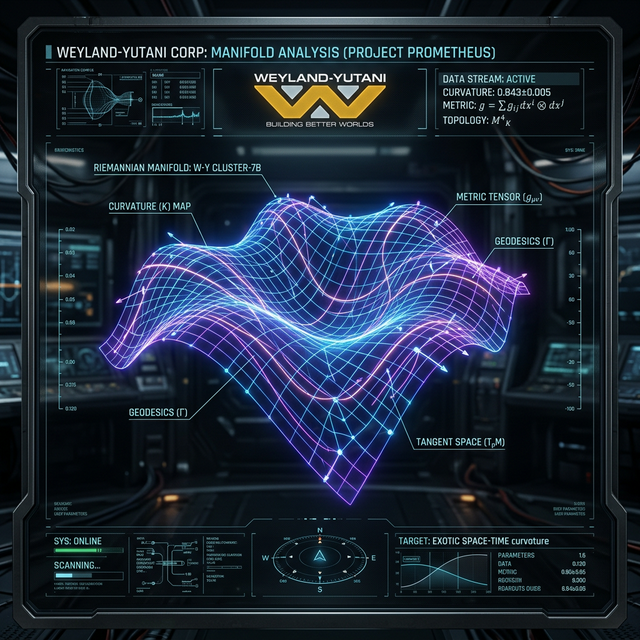
Weyland Corp physicists discovered that the vacuum is not a passive stage, but an active, turbulent 'sub-quantum foam'. At superluminal velocities, this foam exerts a form of temporal friction. The Riemann-Weyland metric was developed to solve this friction by effectively 'greasing' the manifold with polar tachyons, allowing for a transit that bypasses the bubble-stress of traditional warp and instead 'shunts' the vessel through the sub-layers of space-time.
Defining epsilon_t: The Tachyonic Permeability
The core innovation of the Weyland Metric is the introduction of the **Weyland Variable (epsilon_t)** into the Einstein Field Equations. Traditional physics treats the metric tensor *g_uv* as a rigid structure determined by mass and energy distribution. The Riemann-Weyland solution treats it as a fluid property of tachyonic density.
// FIELD EQUATION SYNOPSIS (WEYLAND REVISION)
G_uv + Λ * g_uv = (8 * π * G / c^4) * [T_uv + ε_t * Φ_uv]WHERE Φ_uv REPRESENTS THE TACHYONIC POLARIZATION TENSOR.
By adjusting the values of epsilon_t in real-time, our navigation computers can 'thin' the local manifold to a point of near-zero resistance. This constant recalibration is what allows a Weyland vessel to maintain velocities of 1500c without the massive gravitational shear that would otherwise liquefy any biological cargo.
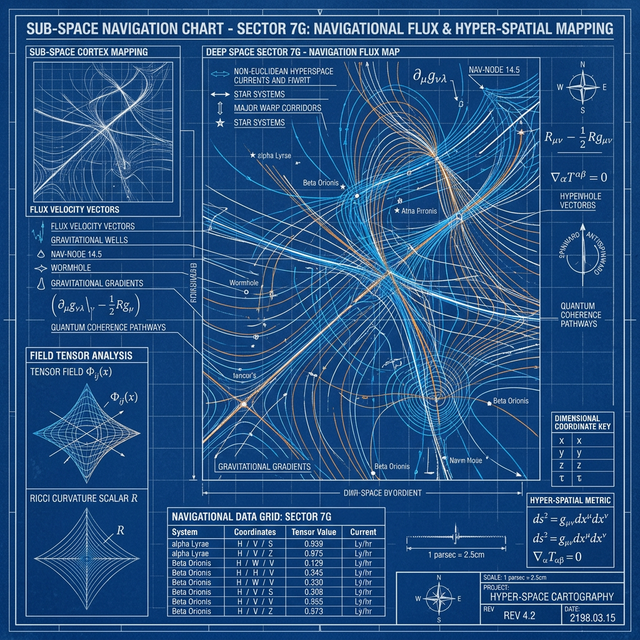
[ FIG 5.2: TORSIONAL DEFORMATION OF THE SUB-QUANTUM MANIFOLD ]
SYSTEM STATUS: RENDER COMPLETE // TACHYONIC OVERLAY ACTIVE
The Hazard of High-Velocity Jumping
Navigation through the Outer Rim sectors, particularly near high-mass objects like the Zeta Reticuli binary system, introduces the phenomenon of 'Space-Time Brittleness'. At extreme Tachyonic density, the manifold stops acting like a fluid and begins to behave like a crystal. If the vessel's shunt frequency is not perfectly synchronized with the local Riemann curvature, the manifold can 'crack'.
This result is **Shear-Drift**—a localized decoherence of the ship's physical structure. In mild cases, this manifest as 'ghost images' or temporal artifacts within the hull. In severe cases, it can lead to the instantaneous disappearance of a vessel, only for it to re-emerge decades later or in a state of molecular fragmentation. Our current Riemann-Weyland algorithms operate with a safety margin of 0.0004%, the highest in the industry.
Real-Time Metric Re-Alignment
A major challenge in FTL travel is that space is not empty. Every star, planet, and black hole creates a 'gravity well' that warps the Riemann metric. To travel in a straight line, one must actually navigate a complex, multi-dimensional curve. Weyland's **Autonomous Correction Loops (ACLs)** utilize a network of tachyonic beacons to ping the manifold 120,000 times per second.
These pings allow the ship's computer to map the 'brittleness' ahead of the vessel and adjust the epsilon_t variable before the ship arrives. This anticipatory navigation is what makes Weyland Corp the world leader in safe, deep-space logistics. We don't just jump into the dark; we illuminate the path with mathematics.
The Infinite Frontier
The future of the Riemann-Weyland metric lies in the 'Zero-Point Shunt'. Our researchers are currently theorizing a method to permanently thin the manifold across major trade routes, creating 'Hyper-Lanes' where transit time between Sol and the Outer Rim could be reduced to mere days. While still in the theoretical stage, the mathematical foundations suggest that we are only beginning to understand the true flexibility of the universe.
— Dr. Victor Aris, Chief Propulsion Theorist, Weyland-Yutani