The Standard Candle
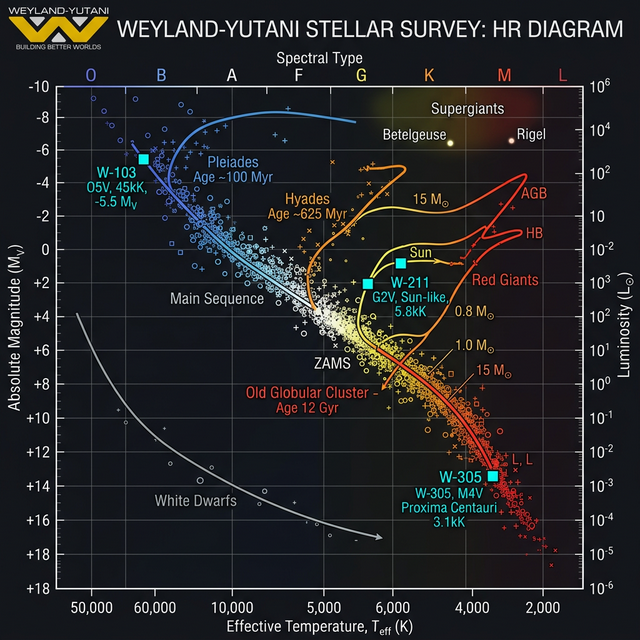
The vast majority of human colonization is centered around G-type and F-type main sequence stars. These 'Standard Candles' provide the thermal stability required for long-term planetary habitation and agricultural seeding. However, from a resource extraction perspective, a stable main sequence star is actually quite lean. The high-energy isotopes required for Tachyonic Shunt Drives are buried deep within the stellar core, far beyond the reach of conventional scoop-drones.
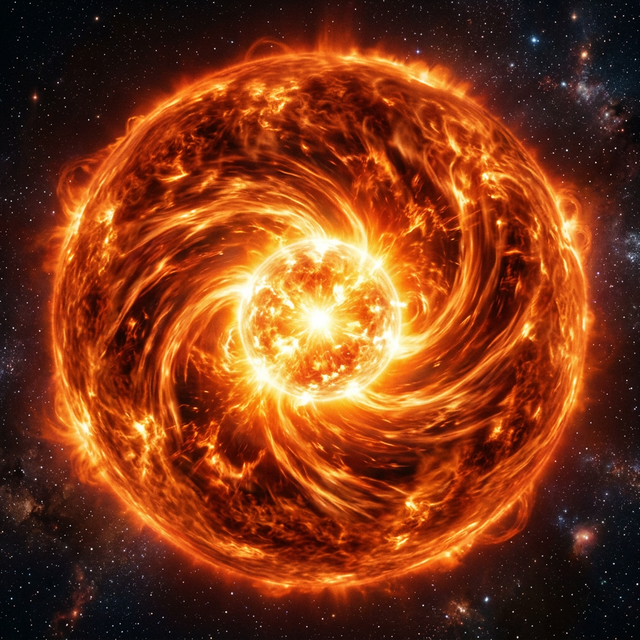
Weyland-Yutani's **Stellar Evolution Data (SED)** program focuses on identifying stars that are nearing the end of their main sequence stability. As a star begins to exhaust its hydrogen fuel, its internal pressure shifts, causing heavier isotopes to migrate toward the outer layers of the corona. These 'Pre-Transition' stars represent the most efficient harvest sites in the known galaxy.
[ FIG 18.2: ISOTOPE YIELD BY STELLAR CLASSIFICATION ]
SYSTEM STATUS: DATA SYNC COMPLETE // ZETA II TRANSITION DETECTED
The High-Risk Threshold
Harvesting material from a dying star is not without risk. The 'Thermal Flare' frequency of a Red Giant is unpredictable, and a single coronal mass ejection can overwhelm even the strongest Aligned Boron-Carbide (ABC) shielding. Weyland-Yutani utilizes **Predictive Solar Modeling (PSM)** to forecast these flares with 99.2% accuracy.
Our extraction arks are equipped with emergency hyper-shunt drives, allowing them to jump to a safe distance in less than 2.4 milliseconds if a flare is detected. This autonomy is managed by a dedicated **Synthetic Logistics Advisor (SLA)** stationed on the primary tender vessel, ensuring zero loss of corporate assets even in the most volatile stellar environments.
Mapping the Frontier
The Zeta II Reticuli system is a prime example of SED-driven planning. While Zeta I is a stable main sequence star, Zeta II is showing signs of early-stage helium-burning transition. This makes it an ideal central hub for the Outer Rim mining network. We have positioned three permanent ISO-Extraction platforms in the Zeta II corona, providing a steady stream of fuel-grade isotopes for all vessels transiting the sector.
This strategic positioning has reduced the cost of FTL travel in the Reticuli sector by 18%, making it the most profitable region in the Weyland-Yutani portfolio. The data gathered here is being used to identify the next 'Resource Hub' in the nearby Gliese system.
The Final Cold Harvest
The final stage of stellar evolution—the White Dwarf—is often ignored by lesser corporations. But at Weyland-Yutani, we see the potential in the relics. White Dwarfs are composed of 'Degenerate Matter'—material so dense that its atoms are forced into a unified quantum state. This matter is the key to our ongoing research into Zero-Point Energy.
We are currently developing a new class of **Sub-Atomic Siphon** that can peel layers of degenerate matter from the surface of a White Dwarf. If successful, this would provide us with a fuel source that is effectively infinite, powering the expansion of humanity to the very edge of the Milky Way.
The Century of Sub-layer Mastery
Our projections for the next standard century show a total shift in emphasis from planetary to stellar resource acquisition. By 2150, we expect 90% of all corporate energy to be derived from Direct-Star Refining. Weyland-Yutani is not just a mining company; we are the harvesters of the stars themselves. We build 'Better Worlds' by utilizing the power of a billion suns.
— Dr. Aris Thorne, Director of Stellar Logistics, Weyland-Yutani